
Okay, so check this out—I’ve spent a lot of late nights poking around Solana blocks. Whoa! It felt like spelunking at first, all hashes and hex. My instinct said this would be messy, but then I found patterns, and they stuck. Initially I thought a blockchain explorer was just a block list, but actually, wait—it’s more like a diagnostic tool and a microscope for on-chain behavior.
Really? Yeah. Solscan makes that microscope usable. It’s fast, and the UI gives you transaction graphs, token transfers, program logs, and inner instructions without twenty clicks. On one hand the raw data is still dense; on the other hand you can follow causal threads—who sent what to whom, which program processed it, and where a transaction failed. I’m biased, but that transparency is what drew me to it, even when other explorers looked shinier but felt shallower.
Here’s the thing. When you open a transaction page you get the top-level summary first. Short. Clear. Then there are the nested parts: inner instructions, pre- and post-balances, logs, and whether any CPI (cross-program invocation) happened. Hmm… sometimes the logs show a cryptic error and you have to trace back through a few program calls to see where things went sideways. That tracing is where Solscan shines, because it surfaces the details in a readable order.
Where to Start — Reading a Solana Transaction
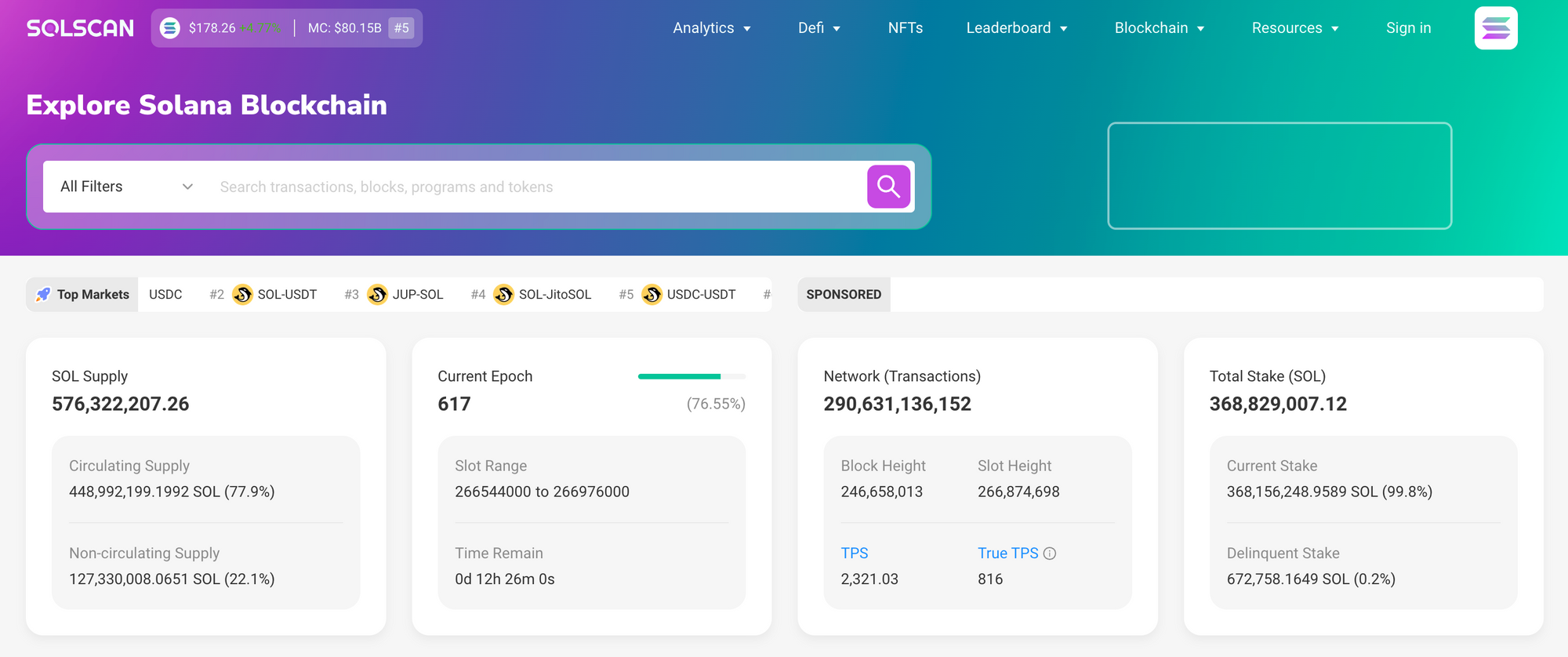
Wow! Start with the signature. Then check status: success or failed. Look at fee, compute units, and which accounts were read or written. Next, scan the logs to figure out why a change happened—did a program invoke another program? Was an SPL token minted or burned? For convenience, the solscan explorer official site bookmarks common views so you can jump straight to token holders or NFT metadata pages.
Something felt off about the first time I tried to diagnose a stuck swap—there were pre-images and then nothing. Seriously? I had to look at inner instructions to spot a CPI that debited a wrapped SOL account before the swap even executed. That little reveal saved me hours. And by the way, if you’re tracking airdrops or retroactive program changes, check the block time and slot numbers closely; they tell you the order that matters, not just the timestamp label.
One trick I use: search by program ID when you see repeated behavior across transactions. It lets you map out which DEX or vault is responsible for a pattern, and sometimes you can infer strategy or front-running attempts. I’m not 100% sure about motives—on-chain signals are noisy—but the behavioral patterns are clear enough to form hypotheses.
Here’s what bugs me about many explorers—they hide inner transfers or label them confusingly. Solscan exposes them, but the UI could be more tutorial-like for beginners. Still, once you suss out the layout, it’s powerful. For advanced users, the CSV export and API endpoints are lifesavers when you’re crunching thousands of transactions for analytics.
Practical Use Cases: When to Open an Explorer
Need to verify an NFT mint? Open the metadata and creators list. Quick sanity check: did royalties point to the expected wallet? Need to debug a failed swap? Read the program logs. Watching airdrop eligibility? Search for historical Snapshots or check token transfers around the snapshot slot. Also—if you see an account with abnormal balance moves, consider searching its signature history to find associated program calls.
My gut reaction is to always check pre- and post-balances first. It’s a small habit, but it quickly tells you whether a failure consumed unexpected funds or compute units. Sometimes a transaction fails yet still burns fees, which is a costly surprise for newcomers. Somethin’ about that friction annoys me, and I whisper a small thanks for explorers that make the consumption obvious.
On the privacy front: Solana isn’t anonymous, it’s pseudonymous. Seeing an address drain across multiple programs often reveals operational strategies—token aggregation, batching, or liquidation flows. These patterns help researchers and devs, though they also make it easier to profile activity across accounts. That tradeoff matters to product folks thinking about privacy-by-design.
Tips, Shortcuts, and Tools I Use
Shortcuts first. Use the search bar to paste an address, signature, or block number. Then toggle views—transaction list, token transfers, or holders. For tokens, the holders tab is gold. It shows distribution and concentration quickly. For more automated work, use Solscan’s API to pull program-specific logs into your local analytics pipeline.
Initially I treated explorers as read-only toys, but then I used exported data to tune an on-chain monitor. Actually, wait—let me rephrase that: I built alerts that trigger on large transfers and non-standard program errors, and those alerts helped catch a bug in a smart contract before it blew up. So yes, explorers are part of a defensive stack for serious projects.
Double words? Yeah, sometimes I’m very very careful, but not always. (oh, and by the way…) keep an eye on compute unit usage. High compute spikes often correlate with complex CPIs or loops inside programs. If a routine suddenly consumes twice the compute, it may be under attack or mutated via a parameter change upstream.
FAQ
How can I tell why a transaction failed?
Check the transaction logs first—Solscan shows program output including explicit error messages most of the time. Then inspect inner instructions and account changes; failed CPIs or insufficient funds usually show up there. If logs are terse, look at the program ID and consult the program’s repo or docs for error codes.
Is Solscan safe to use for contract debugging?
Yes. It’s read-only and useful for tracing execution and token flows. Use it alongside local testnets and on-chain debuggers. I’ll be honest: it shouldn’t be your only tool, but it’s one of the first places I go when something looks odd on mainnet.
Okay, so to wrap this up—no neat concluding paragraph, because blockchain keeps moving and so should our questions. I’m curious, though: what confuses you most when you pull up transaction details? My instinct said this would spark a few follow-ups, and it did… I’ll keep digging, and you should too.